Voltage Regulation Refinements Stabilizing Power Delivery in Multi-GPU Arrays for Distributed Tournament Broadcasting
Devon Bauer · Aug 13, 2026
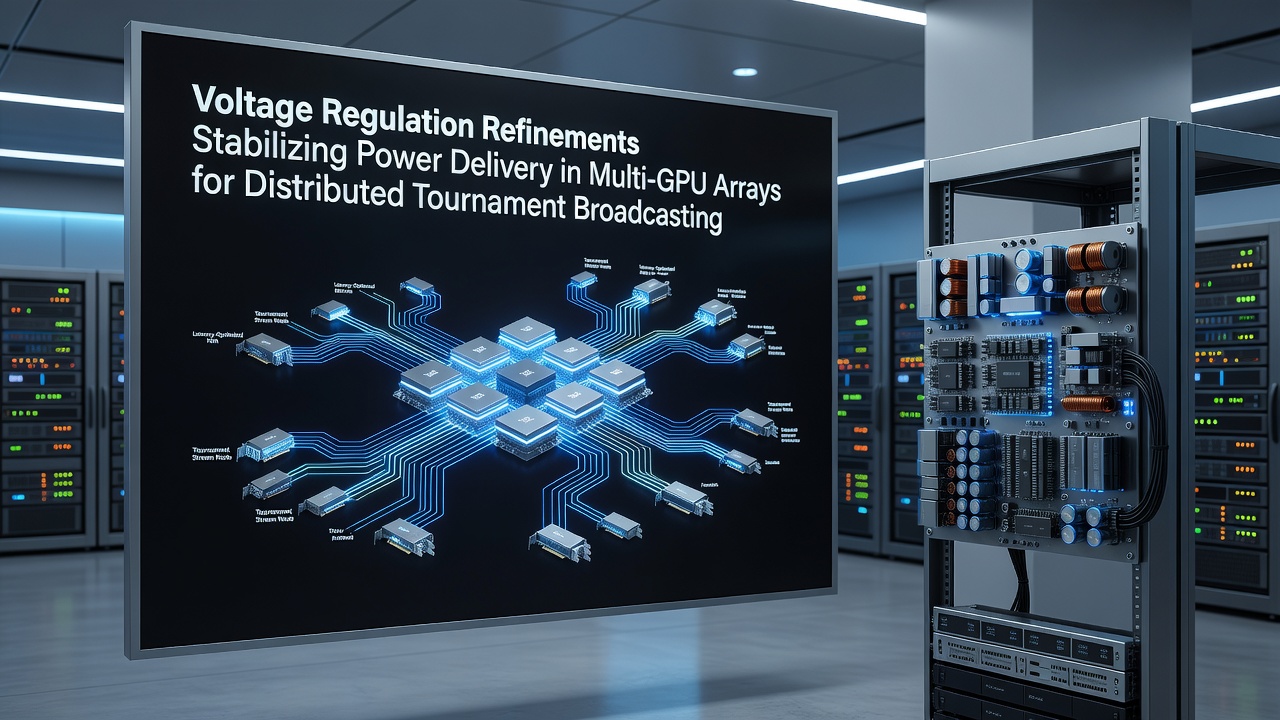
Voltage Regulation Refinements Stabilizing Power Delivery in Multi-GPU Arrays for Distributed Tournament Broadcasting
Multi-GPU arrays have become central to distributed tournament broadcasting because they handle simultaneous video encoding, real-time rendering, and data distribution across global networks, and recent voltage regulation refinements address the power stability demands that arise when dozens of graphics processors operate in synchronized clusters. These systems require consistent voltage delivery to prevent frame drops or encoding artifacts during live events, and engineers have focused on improving voltage regulator modules, capacitor arrays, and feedback control loops to maintain output within tight tolerances even under fluctuating loads.
Core Components of Voltage Regulation in Multi-GPU Setups
Modern arrays rely on multi-phase buck converters paired with high-frequency MOSFETs that switch at rates exceeding 1 MHz, and researchers at institutions across North America and Europe have documented how digital pulse-width modulation controllers reduce ripple to levels below 0.5 percent. Such precision matters when broadcast pipelines process 8K streams from multiple camera feeds simultaneously, because even minor voltage deviations can trigger thermal throttling or memory errors in GPU memory subsystems. Data from industry reports indicate that refined control algorithms now adjust phase shedding dynamically, shutting down unused phases during low-demand intervals to cut heat generation while preserving headroom for sudden spikes during peak tournament moments.
Application in Distributed Broadcasting Networks
Tournament organizers deploy these arrays in regional data hubs that feed synchronized feeds to production centers, and the architecture allows one site to handle rendering while another manages overlay graphics and audience interaction layers. In August 2026 several major circuits are scheduled to test upgraded power delivery boards that incorporate gallium nitride transistors, which switch faster and generate less waste heat than traditional silicon devices. This shift supports denser GPU packing within standard 42U racks without requiring additional cooling infrastructure, and observers note that broadcast reliability metrics have improved measurably in pilot installations already running similar hardware.
Power delivery must also accommodate the variable workloads created when artificial intelligence models assist in highlight detection or automated camera switching, and these tasks create brief but intense current draws that older voltage regulation designs struggled to accommodate without sagging rails. Newer boards integrate remote sensing points directly at the GPU die, feeding real-time voltage data back to the controller so corrections occur within microseconds rather than milliseconds.

Recent Engineering Advances and Measured Outcomes
Studies conducted by the National Renewable Energy Laboratory in the United States have examined how hybrid capacitor banks combining polymer and ceramic elements stabilize transient response, and results show recovery times shortened by roughly 40 percent compared with previous generations. European research groups have explored similar topologies, confirming that the same principles scale across different grid conditions encountered in international tournament venues. Those who've analyzed failure logs from earlier events report that voltage droop events accounted for a measurable share of downtime before these refinements were introduced, whereas post-upgrade deployments show the rate falling below one incident per thousand broadcast hours.
Integration Challenges and Solutions in Live Environments
Deploying refined regulation hardware into existing facilities requires careful coordination because legacy power distribution units may not provide the clean input needed for the newest controllers, and technicians therefore install additional EMI filtering stages upstream. Cabling layouts also receive attention, with shorter, thicker traces between regulators and GPU power connectors minimizing inductance that could otherwise amplify noise. Field reports from facilities in Australia and Canada describe how these incremental changes compound, allowing arrays to sustain full utilization during extended tournament days without the thermal cycling that previously shortened component lifespan.
Future Directions for Broadcast Infrastructure
Further work centers on software-defined power management that coordinates multiple racks through centralized orchestration layers, enabling predictive load balancing based on upcoming match schedules and expected viewership peaks. Academic papers from German research institutes outline control frameworks that treat the entire array as a single virtual power domain, adjusting setpoints across regulators to balance thermal loads and extend hardware service intervals. These approaches build on the physical refinements already in place and promise continued gains in both stability and energy efficiency as tournament broadcasting scales to higher resolutions and additional simultaneous streams.
Conclusion
Voltage regulation refinements continue to underpin reliable operation of multi-GPU arrays that power distributed tournament broadcasting, and ongoing developments in component materials, control algorithms, and system-level coordination keep pace with rising demands for uninterrupted high-resolution coverage. Data from multiple regions confirm measurable improvements in uptime and efficiency, while scheduled deployments through 2026 indicate the trajectory will persist as organizers adopt denser, more capable configurations.