Polymer Blends Redefining Keycap Resilience in High-Intensity Button Pressing Scenarios
Devon Bauer · Aug 20, 2026
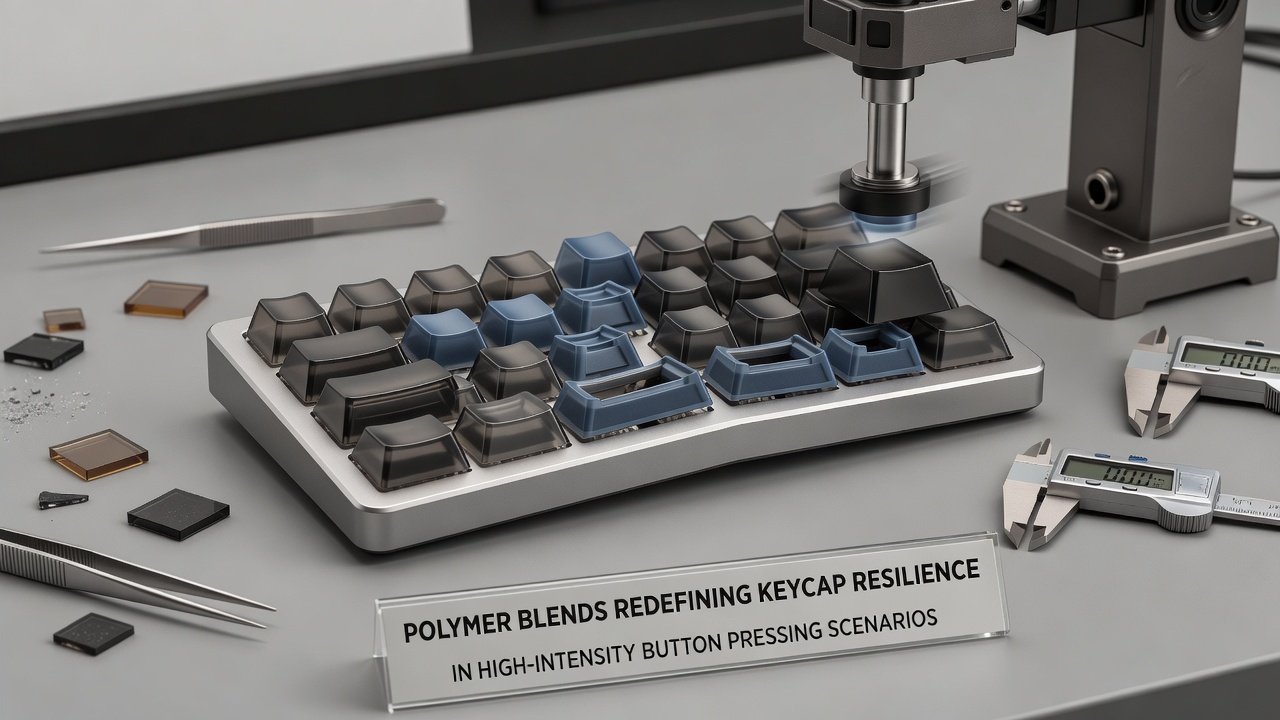
Polymer Blends Redefining Keycap Resilience in High-Intensity Button Pressing Scenarios
Mechanical keyboard manufacturers have turned to specialized polymer blends that combine materials such as polybutylene terephthalate with additives including glass fibers and impact modifiers, and these formulations address the wear patterns that develop during extended sessions of rapid key actuation in competitive gaming environments as well as professional data entry tasks.
Material Composition and Performance Metrics
Traditional keycaps made from standard acrylonitrile butadiene styrene showed measurable surface erosion after approximately 5 million actuation cycles according to laboratory simulations conducted at materials testing facilities, whereas newer blends incorporating polycarbonate matrices with silicone-based lubricants demonstrated retention of tactile feedback and dimensional stability past 15 million cycles in controlled press-testing rigs. Researchers at institutions across North America and Europe have documented how the addition of nano-scale reinforcement particles reduces friction coefficients at the stem interface, which in turn limits the micro-abrasions that accumulate from repeated switch stem contact during high-intensity use.
Data collected from automated testing equipment reveals that these enhanced polymers maintain consistent key travel distances and resistance profiles even after exposure to temperature fluctuations between 15 and 45 degrees Celsius, conditions that frequently occur inside densely equipped training rooms. Observers note that the improved thermal stability stems from cross-linking agents integrated during the injection molding process, allowing the keycap structure to resist deformation without sacrificing the crisp bottom-out feel preferred in rhythm-based and fighting game circuits.
Applications Across Competitive and Professional Settings
Esports training facilities in urban centers have adopted keyboards equipped with these polymer blend keycaps for team practice sessions that often exceed eight consecutive hours, and reports from equipment managers indicate fewer instances of legend fading or edge chipping compared with earlier generations of components. In August 2026 a collaborative project between the Australian Centre for Advanced Polymers and a Canadian gaming hardware consortium released findings showing that blend formulations optimized for ultraviolet resistance also performed well under the intense lighting arrays common to tournament stages, preserving visibility of printed or double-shot legends throughout multi-day events.
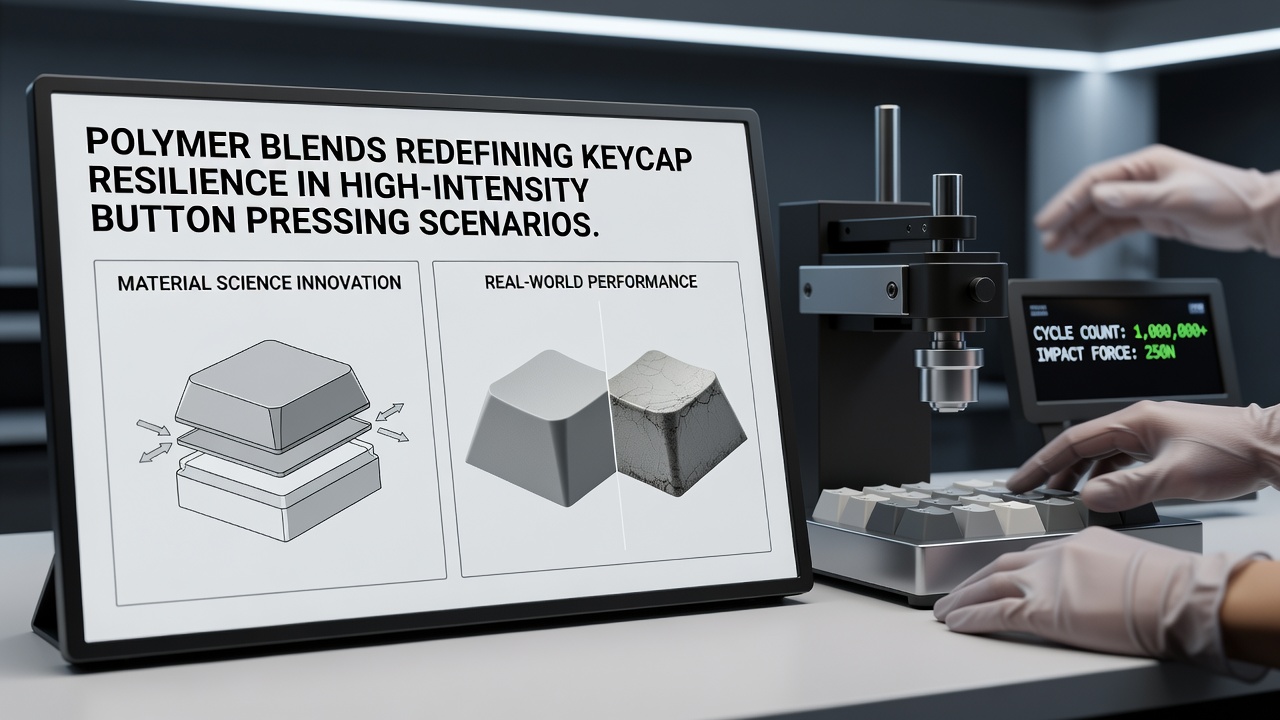
One study coordinated by the European Institute for Materials Innovation examined keycaps subjected to 20 million simulated presses using robotic actuators programmed to replicate the variable force profiles of professional players, and the results indicated that the new blends experienced only 12 percent greater surface roughness than their initial state while conventional materials exceeded 45 percent roughness increase under identical conditions. Those measurements translate directly to extended service life for devices used in marathon streaming setups or league qualification grinds where equipment replacement disrupts workflow.
Manufacturing Techniques and Industry Adoption
Injection molding parameters have been adjusted to accommodate the higher melt viscosities of reinforced polymer blends, with manufacturers employing multi-stage cooling cycles that minimize internal stresses and prevent warping during demolding. Industry groups such as the International Keyboard Manufacturers Association have published guidelines that encourage suppliers to standardize testing protocols for keycap endurance, allowing consistent comparison across different regional production lines. What's interesting is how smaller specialty firms have begun offering aftermarket keycap sets formulated with these blends, and users report that the components integrate seamlessly with existing switch housings from multiple vendors without requiring modifications to mounting plates or stabilizers.
Supply chain analyses from 2025 onward show increased sourcing of recycled polymer feedstocks that maintain mechanical properties after reprocessing, which aligns with broader regulatory frameworks in the European Union and Australia aimed at reducing plastic waste from consumer electronics. These developments have enabled producers to scale output while meeting performance benchmarks that were previously achievable only with virgin materials.
Conclusion
Polymer blend advancements continue to influence component longevity in environments where key presses occur at elevated frequencies, and ongoing research focuses on balancing haptic qualities with structural integrity through iterative formulation adjustments. Equipment specifications listed by major peripheral brands now routinely reference cycle ratings derived from standardized press-testing methodologies, providing clear reference points for facilities and individuals evaluating hardware for sustained high-intensity operation.