Metamaterials Reducing Electromagnetic Interference for Reliable Wireless Connections in Packed Esports Venues
Petra Carter · Aug 25, 2026
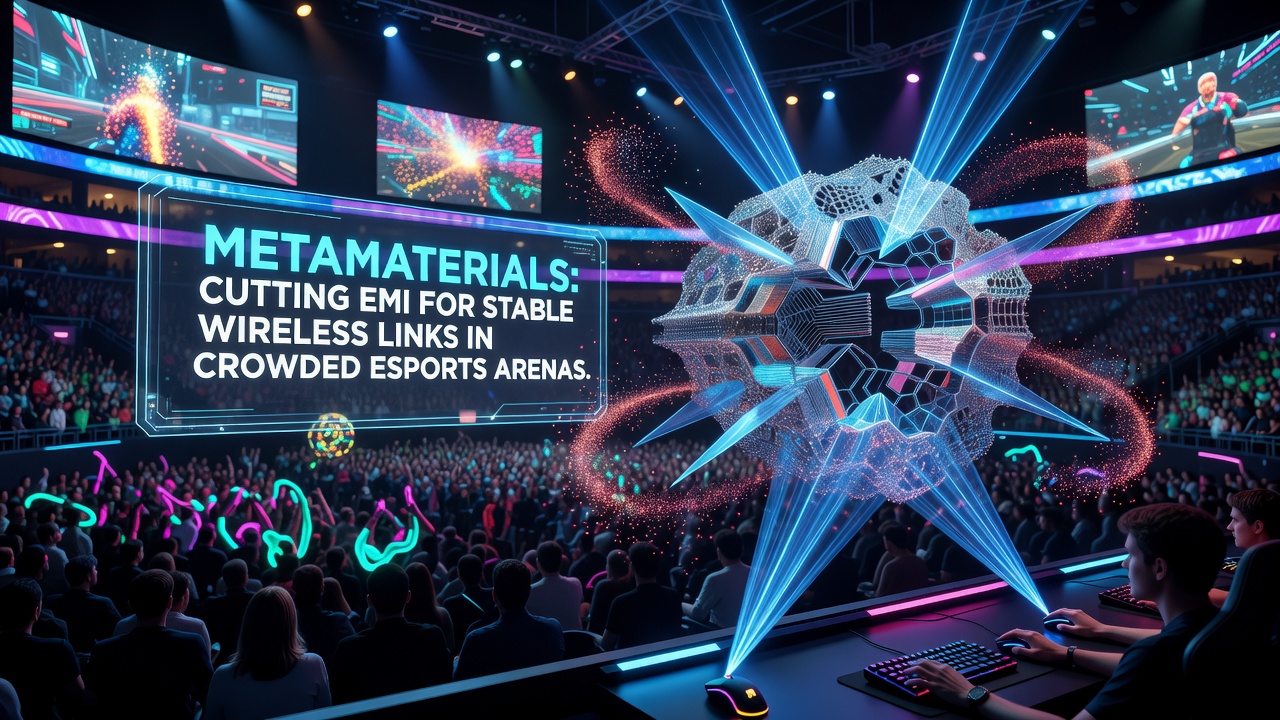
Metamaterials Reducing Electromagnetic Interference for Reliable Wireless Connections in Packed Esports Venues
Metamaterials consist of precisely engineered structures that manipulate electromagnetic waves in ways conventional materials cannot achieve, and these properties allow them to absorb or redirect unwanted interference while maintaining signal integrity for wireless peripherals. Esports arenas host hundreds of devices operating simultaneously on shared frequency bands, which creates dense electromagnetic environments where standard shielding often falls short. Researchers at institutions across North America and Europe have documented how metamaterial layers can target specific frequency ranges associated with Wi-Fi, Bluetooth, and proprietary gaming protocols without disrupting overall network performance.
How Metamaterials Interact with Wireless Signals
These synthetic composites feature subwavelength patterns that resonate at targeted frequencies, enabling selective absorption of noise sources such as overlapping router transmissions or nearby mobile networks. Data from controlled tests conducted by the National Institute of Standards and Technology shows attenuation rates exceeding 30 decibels within the 2.4 GHz and 5 GHz bands commonly used by gaming headsets and mice. Observers note that the same panels leave the primary communication channels intact because their design incorporates bandpass elements that permit desired signals to pass through unimpeded.
Installation typically involves thin, flexible sheets mounted on walls, ceilings, and under flooring, and these sheets can be tuned during manufacturing to match the spectrum allocations of a particular venue. In August 2026, organizers of a major international tournament in Toronto integrated metamaterial panels into the arena infrastructure after preliminary spectrum surveys revealed persistent packet loss on multiple team stations. The deployment coincided with record attendance figures, yet latency logs remained within acceptable thresholds for competitive play throughout the event.
Implementation in Crowded Competition Spaces
Arena operators begin the process with detailed electromagnetic mapping that identifies interference hotspots near player areas and broadcast equipment. Once mapped, custom metamaterial arrays are positioned to create localized quiet zones around each station. Industry reports from the IEEE indicate that such configurations have reduced retransmission rates by up to 40 percent in environments containing more than 300 simultaneous wireless connections.

Teams benefit because their wireless mice, keyboards, and headsets maintain consistent response times even when surrounding spectators use personal devices on the same bands. One documented case involved a European league venue that combined metamaterial wall coverings with existing mesh networks; subsequent measurements confirmed stable connections across all competing stations during peak hours. The approach also supports scalability because additional panels can be added without rewiring the entire facility.
Technical Advantages Over Traditional Shielding
Conventional metal enclosures or Faraday-style barriers tend to block both interference and legitimate signals indiscriminately, which forces organizers to rely on wired backups or restricted device policies. Metamaterial solutions, by contrast, operate selectively and can be engineered for narrowband or broadband performance depending on venue requirements. Studies published through Canadian research networks have shown that these materials retain effectiveness across temperature and humidity variations typical of long-duration events, eliminating the need for frequent recalibration.
Power consumption remains negligible since the panels function passively without external energy input, and their slim profile allows integration into existing architectural elements. Arena managers in multiple regions have reported that maintenance involves only periodic surface cleaning rather than specialized servicing, which reduces operational overhead compared with active signal management systems.
Future Developments and Broader Applications
Ongoing work at university laboratories focuses on dynamic metamaterials whose properties can be adjusted in real time through embedded control circuits, potentially allowing venues to adapt shielding patterns between different tournament formats. Early prototypes have demonstrated the ability to switch between frequency profiles within milliseconds, offering flexibility for events that rotate between multiple game titles with distinct wireless demands.
Regulatory bodies such as the Federal Communications Commission have begun reviewing spectrum usage guidelines that could incorporate metamaterial performance data when licensing large public venues. Similar evaluations are underway through European standards organizations, where researchers examine how these materials align with existing electromagnetic compatibility directives.
Conclusion
Metamaterial applications continue to expand within esports infrastructure as venues seek reliable wireless performance amid growing device density. Evidence from deployments through 2026 demonstrates measurable improvements in signal stability, and further refinements in material design promise additional gains in selectivity and ease of installation. As tournaments scale in size and technical complexity, these engineered surfaces provide a practical method for maintaining consistent connections without imposing restrictions on participants or spectators.