Echoes in the Code: How Procedural Generation Algorithms Are Reshaping Narrative Structures in Open-World Adventures
Sofia Schmid · Aug 15, 2026
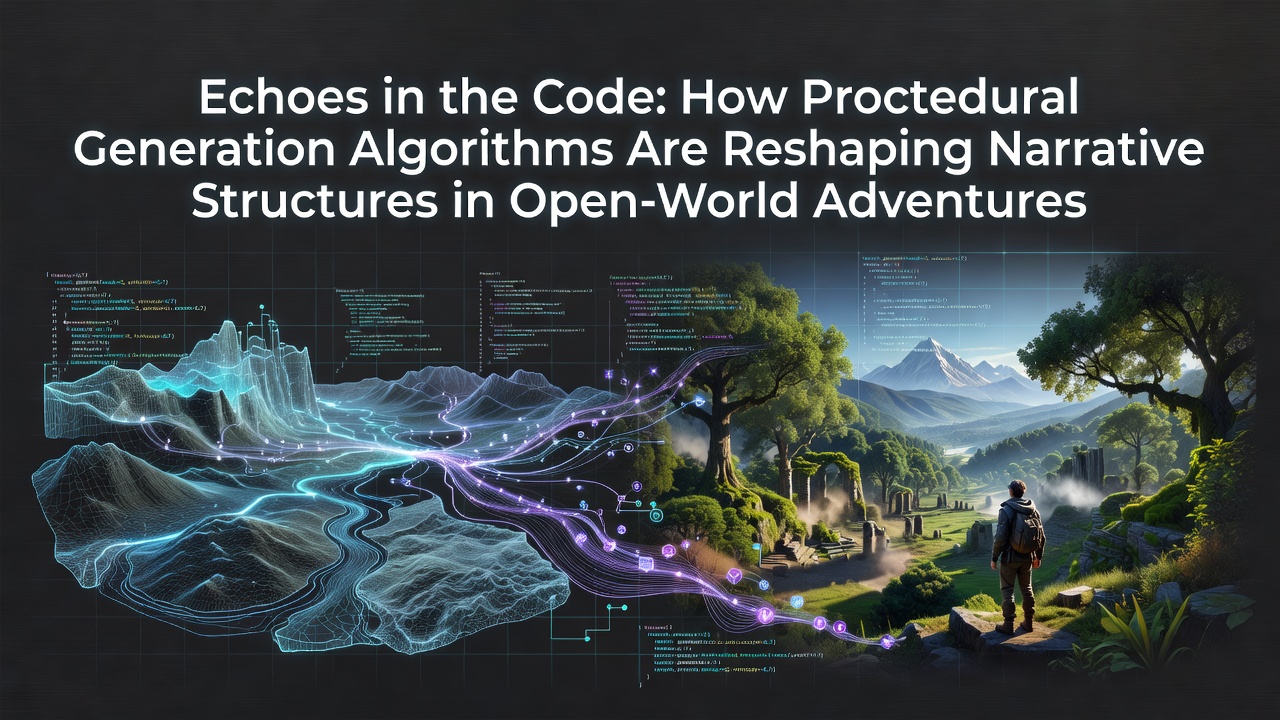
Echoes in the Code: How Procedural Generation Algorithms Are Reshaping Narrative Structures in Open-World Adventures
Procedural generation algorithms create game content through mathematical rules and randomization rather than fixed designs, and this approach has steadily influenced narrative construction in open-world adventures since the early 2000s. Developers apply techniques such as noise functions, grammar-based systems, and machine learning models to produce quests, character interactions, and plot developments that vary across play sessions. Research from the University of Alberta indicates that these methods allow worlds to expand without proportional increases in manual scripting, which supports larger player-driven stories while maintaining computational efficiency.
Core Mechanisms Behind Narrative Procedural Systems
Algorithms process parameters like player location, past choices, and environmental data to assemble story elements on demand, and this process often relies on weighted graphs or recurrent neural networks trained on existing narrative datasets. When a player enters a new region, the system evaluates variables such as faction relationships or resource availability before generating dialogue trees or mission objectives that align with those conditions. Observers note that such integration prevents static repetition because each traversal through the same area can yield distinct encounters tied to the current state of the simulation.
Developers combine these tools with traditional writing to anchor key events while letting secondary threads emerge organically, and evidence from industry reports shows this hybrid model reduces development time for expansive titles. For instance, quest generation modules pull from pools of templates that incorporate contextual modifiers, resulting in missions that reflect local ecology or political tensions without requiring bespoke code for every variation.
Shifts in Player Agency and Story Branching
Open-world adventures that incorporate procedural narratives give players more influence over plot progression because choices alter the underlying data models that future generations reference. A decision to support one faction can shift probability weights for encounters elsewhere on the map, creating ripple effects that feel organic rather than scripted. Studies conducted at the Technical University of Munich have documented how these feedback loops encourage repeated playthroughs, as the same initial conditions rarely produce identical sequences of events.
Yet the approach also introduces constraints, since algorithms must respect coherence rules to avoid nonsensical outcomes that break immersion. Engineers implement validation layers that check generated content against predefined lore constraints before presenting it to the player, and this step ensures consistency across the generated material. Data collected from large-scale beta tests reveals that titles balancing procedural freedom with hard narrative anchors maintain higher completion rates than purely randomized experiences.
Case Examples from Recent Titles

Several released games illustrate these techniques in practice, including systems that generate regional histories based on simulated events running in the background. One title released in 2024 used cellular automata to model the spread of rumors across settlements, which then influenced available side stories and merchant inventories. Players who revisited areas months later encountered changed alliances and new conflicts that stemmed directly from earlier algorithmic simulations rather than developer-authored cutscenes.
Another project employed transformer-based language models fine-tuned on fantasy corpora to draft dynamic conversations that reference player history and world state, and internal metrics shared at the 2025 Game Developers Conference showed reduced writer workload alongside increased dialogue volume. As of August 2026, several studios have announced expansions that further integrate real-time weather and economic simulations into narrative triggers, allowing events like resource shortages to spawn refugee story arcs automatically.
Technical and Design Challenges
Scaling procedural narrative systems demands careful tuning of randomness to preserve dramatic tension, because unchecked variance can dilute emotional payoff. Teams address this through tunable parameters that bias toward certain archetypes during key story phases, and testing protocols now include automated playthroughs that flag coherence breaks for human review. Reports from the Interactive Software Federation of Europe highlight ongoing work on standardized evaluation frameworks that measure both narrative variety and logical consistency across generated content.
Hardware limitations also shape implementation choices, since complex story generation must run alongside rendering and physics calculations without frame drops. Optimized approaches often precompute probability tables during loading screens or offload lighter inference tasks to cloud services when available, allowing console and PC versions to deliver comparable narrative depth despite differing local resources.
Conclusion
Procedural generation continues to expand the scope of narrative possibilities in open-world adventures by shifting from static scripts toward responsive, state-aware story construction. Current implementations blend algorithmic flexibility with authored anchors to deliver coherent experiences that adapt to individual play patterns. Ongoing academic and industry efforts focus on refining coherence checks and performance optimizations, which supports further growth in this area through 2026 and beyond.