Ceramic composites redefining heat dissipation patterns within compact desktop builds for dense urban esports training facilities
Jakob Foster · Jun 2, 2026
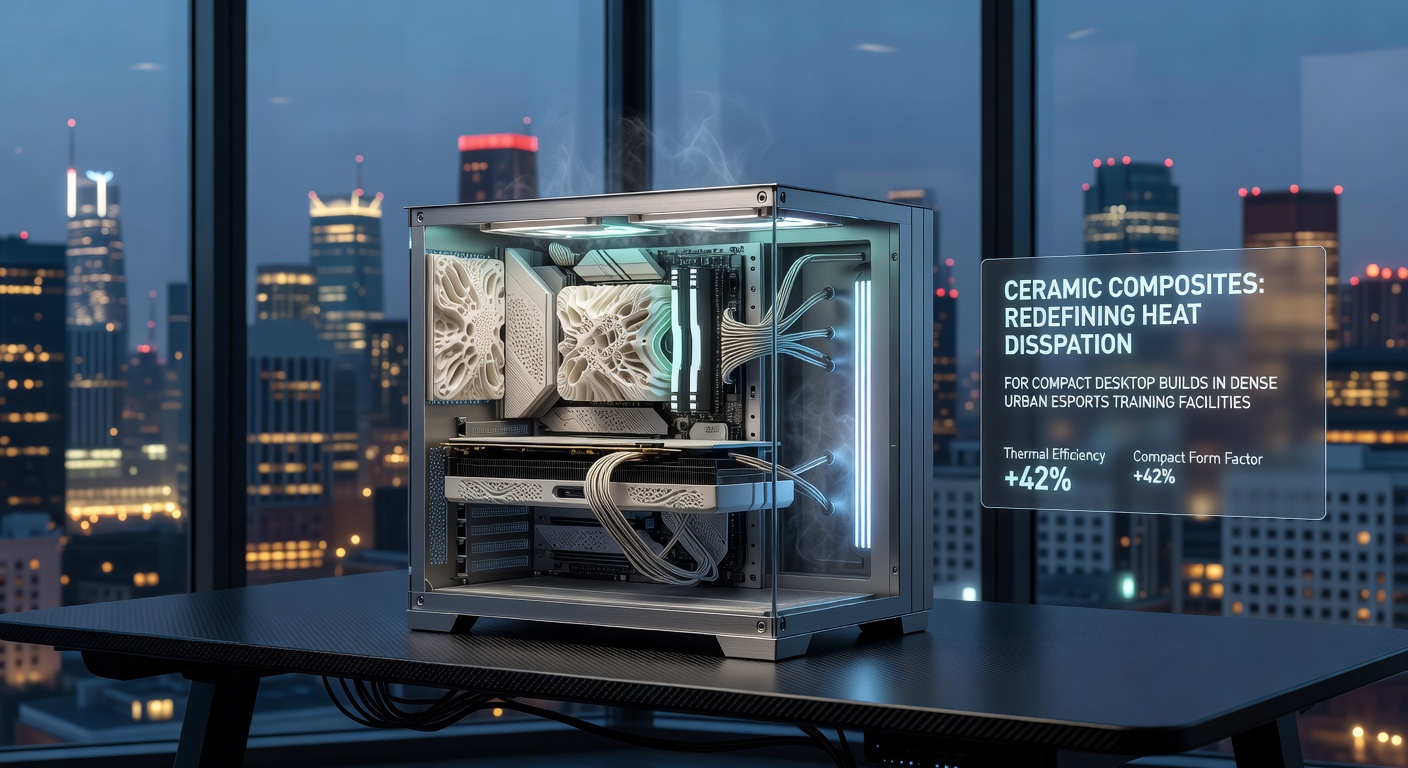
Ceramic composites redefining heat dissipation patterns within compact desktop builds for dense urban esports training facilities
Compact desktop systems have become standard in urban esports training facilities where space constraints meet high-performance demands, and ceramic composites now play a central role in managing the resulting thermal loads. These materials combine ceramic matrices with reinforcing fibers to create structures that conduct heat efficiently while occupying minimal volume, which allows builders to pack more processing power into smaller chassis without triggering thermal throttling during extended training sessions.
Traditional metal heat sinks often fall short in such environments because their bulk and weight limit design flexibility, yet ceramic composites offer comparable or superior thermal conductivity in thinner profiles. Researchers at materials laboratories have documented how silicon carbide and alumina-based composites transfer heat laterally across surfaces at rates that reduce localized hot spots by measurable margins, and this property proves especially useful in facilities where multiple rigs operate side by side in climate-controlled rooms.
Material Properties Driving Adoption
Ceramic composites achieve high thermal conductivity through controlled microstructure alignment, and data from industry testing shows values exceeding 200 W/m·K in optimized formulations. This performance stems from the way reinforcing phases channel phonons while the matrix resists deformation at elevated temperatures, allowing components to maintain structural integrity during peak loads that occur in competitive practice environments.
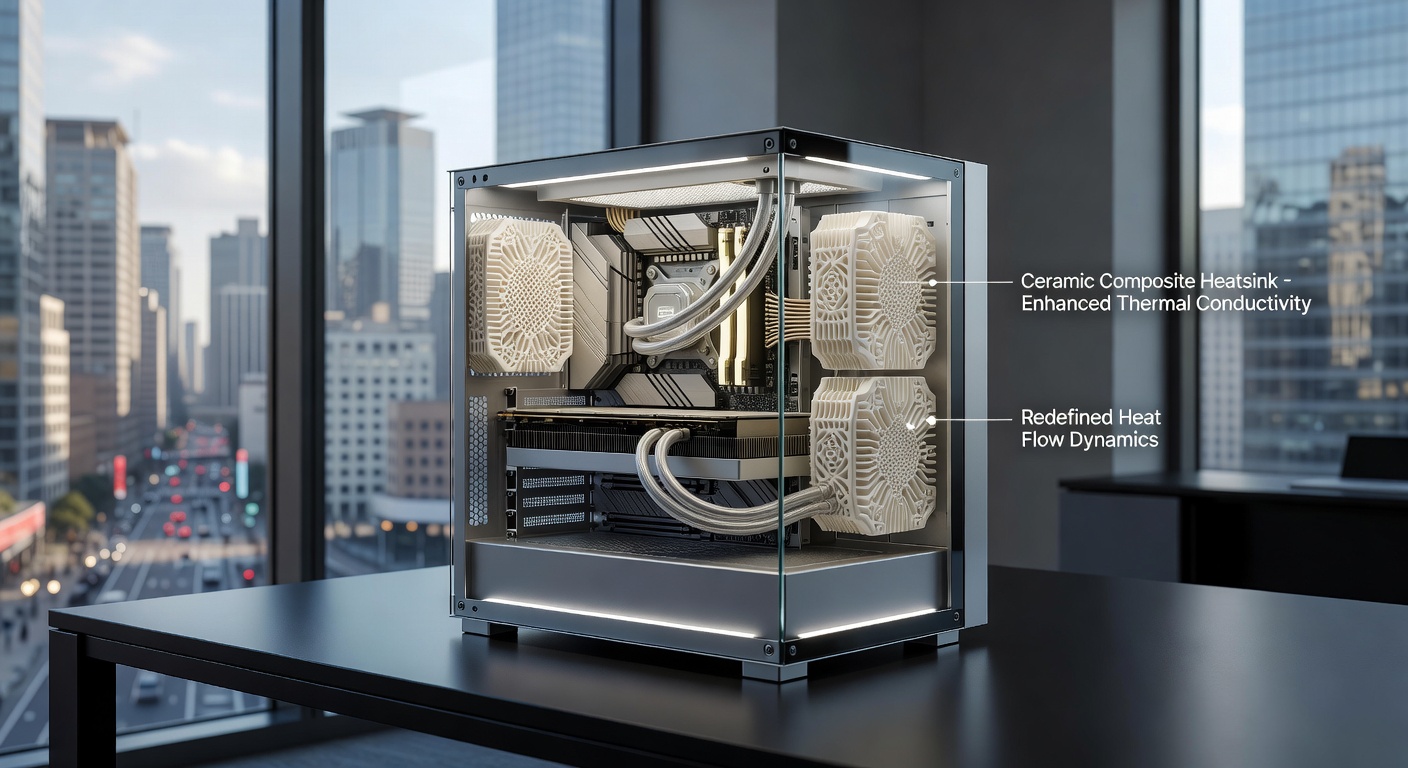
Engineers integrate these composites as heat spreaders, vapor chamber lids, and even structural panels that double as thermal interfaces. In one documented build sequence, technicians bonded composite plates directly to GPU dies using phase-change materials, which distributed heat across larger surface areas before it reached exhaust fans, and facility logs recorded lower average component temperatures compared with previous aluminum-only configurations.
Heat Dissipation Patterns in Constrained Spaces
Within compact desktop builds, airflow paths become critical because case volumes often fall below 20 liters. Ceramic composites reshape these patterns by permitting designers to position heat-generating elements closer together without creating recirculation zones. Computational fluid dynamics models from academic groups demonstrate that composite fins oriented at specific angles generate laminar channels that pull cooler intake air across multiple heat sources simultaneously.
Facilities in high-density urban settings report that such arrangements reduce the need for oversized cooling fans, which in turn lowers acoustic output during team training blocks. Observers note that the redirected airflow also helps maintain consistent humidity levels around electronics, since less aggressive fan speeds limit moisture introduction from external air intakes.
Integration Challenges and Solutions
Adoption requires careful matching of thermal expansion coefficients between composites and adjacent silicon or copper parts, and manufacturers address this through graded interface layers that prevent delamination during repeated thermal cycling. Training facility technicians have adopted standardized mounting protocols that include torque-limited fasteners and pre-applied thermal interface compounds, which together ensure reliable contact pressure over months of continuous operation.
Supply chains for these specialized composites have expanded since production scaled in 2024, and procurement records from multiple city-based centers indicate lead times have shortened while material consistency has improved. Quality verification now includes ultrasonic scanning for internal voids, a step that catches defects before assembly and reduces field failures in high-utilization environments.
Facility-Level Impacts in Urban Settings
Dense urban esports training facilities often operate dozens of stations within single-floor layouts, and the shift to ceramic-enhanced builds has allowed operators to increase station counts without expanding floor space or upgrading HVAC infrastructure. Energy monitoring data collected through mid-2026 shows reduced overall power draw for cooling per rig, because composite systems reach steady-state temperatures faster and require shorter fan ramp-up periods.
One collaborative project involving several North American centers compiled operational statistics through June 2026 that linked composite adoption to extended hardware service intervals. The figures, hosted by the National Institute of Standards and Technology, highlight fewer component replacements tied to heat-related degradation. Similar patterns appear in reports from European research networks tracking parallel installations across training venues.
Looking Ahead
Further refinements focus on additive manufacturing techniques that print composite structures with internal microchannels, which could eliminate separate heat pipes in future compact designs. Pilot programs at select facilities already test these prototypes, and early results suggest additional gains in heat spreading uniformity across GPU and CPU clusters running synchronized workloads.
Conclusion
Ceramic composites continue to alter how heat moves through compact desktop systems deployed in space-limited esports environments, supported by measurable improvements in thermal metrics and operational uptime. As production methods advance and integration practices standardize, these materials are positioned to support higher equipment densities while preserving reliability across continuous training cycles.